This one is pretty niche, but it saved me some time so it's worth writing down.
I needed to embed a font directly into my resume PDF. Not a CSS @import, not a <link> tag — I needed the actual TTF file URL so I could reference it in a Node script that generates the PDF. The problem is Google Fonts doesn't really advertise where the font files live.
The Trick
When you visit a Google Fonts embed URL in a browser — something like:
https://fonts.googleapis.com/css2?family=Inter:wght@400;700&display=swap
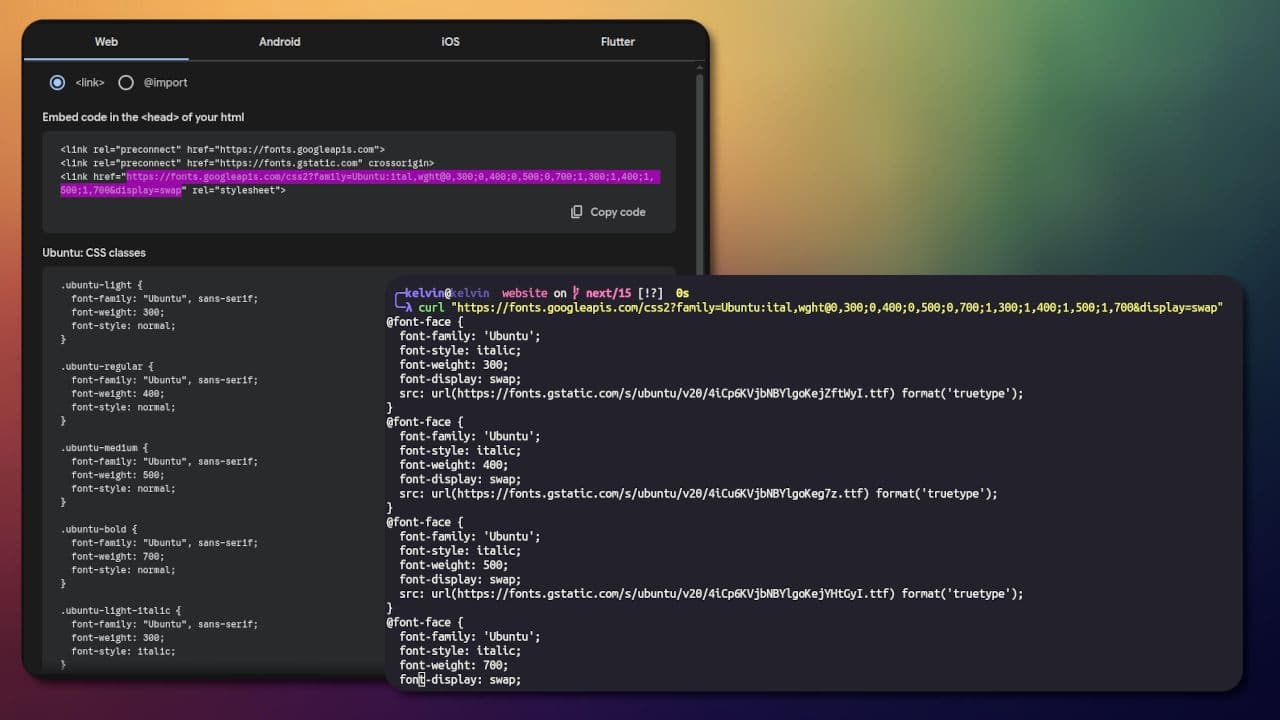
Google detects your browser's user agent and returns WOFF2 URLs, which are optimized for the web. But if you curl that same URL without spoofing a browser user agent, Google falls back to serving TTF URLs instead:
curl "https://fonts.googleapis.com/css2?family=Inter:wght@400;700&display=swap"
The response is plain CSS with src: url(...) declarations pointing directly to the font files on Google's CDN:
@font-face {font-family: 'Inter';font-style: normal;font-weight: 400;src: url(https://fonts.gstatic.com/s/inter/v13/UcCO3FwrK3iLTeHuS_fvQtMwCp50KnMw2boKoduKmMEVuLyfAZ9hiJ-Ek-_EeA.ttf)format('truetype');}
Copy that URL and you have a direct link to the TTF file. No scraping, no guessing, no digging through browser network tabs.
Why curl Specifically
Browsers and curl send different User-Agent headers. Google Fonts uses that header to decide which format to serve:
- Browser → WOFF2 (smaller, modern)
- curl / no user agent → TTF (universal fallback)
You can verify this yourself by comparing the output with and without a browser user agent:
# Returns TTF URLs (no user agent)curl "https://fonts.googleapis.com/css2?family=Inter:wght@400;700&display=swap"# Returns WOFF2 URLs (spoofed browser user agent)curl -A "Mozilla/5.0" "https://fonts.googleapis.com/css2?family=Inter:wght@400;700&display=swap"
My Use Case
I needed this for my resume, which is generated as a PDF using a Node script. The PDF renderer I was using required a direct font URL at build time rather than a CSS import it could parse itself. Plugging the TTF URL directly into the script was the cleanest solution — no downloading and committing font files, just a URL that always points to the latest version Google hosts.
It's a small trick, but one of those things that's annoying to figure out the first time and trivial once you know it.