
A while ago I watched this video about Matt Pocock's teach skill, and I wanted to take it for a test drive to see how effective it really was. In the video, Matt uses it to learn how to solve a Rubik's cube. Unfortunately for me, I already learned that back in high school, so I picked something way harder: chess.
To be completely honest, I've already been using this skill to learn programming topics. Lately that's mostly agentic engineering and systems design. But there are already plenty of videos like this one about how useful it is in that domain, so I thought it would be more interesting to write about a general life skill instead.
If you haven't seen it, the teach skill turns Claude into a tutor that builds a course around you. It doesn't just dump information. It keeps notes on how you learn: what you already know, what you got wrong, what clicked, and what you told it you care about. Those notes shape every lesson that comes after. Each lesson is planned around the zone of proximal development, the idea that you learn best from material just past what you can already do on your own. Too easy and you're bored; too far ahead and nothing sticks. As it learns more about you, it adjusts the difficulty and the topic to stay in that zone. I wanted to see how this held up over a longer stretch than just a weekend so I picked a skill that takes months, where the course has to keep adapting as I improve (and as I plateau). Chess seemed like a good test.
Where I started
When I started the lessons I was hovering just under 700 rapid on chess.com. My "training" up to that point was watching random chess videos on YouTube and playing every day. I still couldn't read chess notation. There were periods of intense grinding, mostly when I was stuck at 400, or when I got tilted and dropped from 600 back down to 490, but I'd never done any structured learning.
My openings were basically muscle memory. As White I forced some kind of Queen's Gambit every game. As Black I played the same first few Sicilian or Old Benoni moves no matter what my opponent did.
The first prompt
Before starting, I made a new directory and dropped in a download of my last 50 games from chess.com as a PGN file. Then I ran the skill with this prompt:
i want to get better at chess, in this directory i have my last 50 games from chess.com in a pgn file, i am currently hovering around 700 elo and would like to get to 1000 by the end of the year. in terms of openings i usually force some kind of queens gambit as white and default to scilian and old benoni as black, just the first few moves and not really taking into account my opponents moves. i still do not know chess notation, but open to expanding my openings repetoire. mid game tactics i think im okay but not amazing, and end games i am most familiar with 2 rooks, queen, or pawn end games. still struggling with 1 rook end games and other combinations of pieces.
From that, the skill set up a small course directory. A month later it looks like this:
teach-chess/├── MISSION.md # the goal: 700 → 1000 by Dec 31├── NOTES.md # what it knows about me and my games├── RESOURCES.md # vetted articles, videos, books├── learning-records/ # 22 short records of what it learned about me├── lessons/ # 15 HTML lessons├── reference/ # cheat sheets (opening map, mate patterns, ...)├── assets/ # interactive boards, puzzles, opening trainers└── tools/ # python scripts that build puzzles from my games
The lessons aren't walls of text. They're HTML pages with interactive boards, move arrows, quizzes, and opening trainers where I click through the moves myself. The puzzles come from my own games, which I'll get to in a bit.
My self-assessment was wrong
The first thing it did was run all 50 games through Stockfish and figure out where I actually lost. I was convinced endgames were my problem, specifically single rook endgames. The data said otherwise:
- Of 21 losses decided by one big mistake, only 2 happened in the endgame
- 17 of 21 were a piece left hanging or a free capture I didn't notice, mostly before move 20
- In 8 losses I had been up +3 or better at some point
- 15 games had a forced mate that I let slip
It pushed rook endgames out of scope entirely, citing Silman's endgame course, which doesn't cover them until the 1200 to 1399 rating band. That was the moment I started trusting it. It wasn't just teaching me what I asked for; it was checking whether what I asked for was the right thing.
Steering it
You can definitely tell from the lesson history when I pushed it toward what I was interested in or struggling with. It wanted to start at the very beginning with notation, since every later lesson depends on it. That was low priority for me. I just wanted to win games, and I can visually tell where my pieces are, so I told it to shift to openings.
It didn't argue. It wrote a learning record about the change, which in hindsight is the most interesting part of the skill:
# Openings before safety drills: learner reset the prioritiesOn 2 Oct 2026, after lesson 1, the user asked to skip the planned "Is it safe?"blunder-check lesson. They said they already know the concept, and that theirblunders come from tunnel vision and lack of awareness in the moment...**Implications**: The next lessons are opening branches, starting with the QGA(lesson 2). Don't re-teach safety checks as a standalone topic. Fold awarenessinto opening drills instead...
Every one of these records ends with an Implications section, and those implications actually show up in later lessons. Since it kept notation as a side quest, every move in every lesson is shown on a board with a plain English explanation next to it.
Once I was happy with the openings I had, I told it to go straight to middlegame awareness and checkmate patterns. Later, when I felt more confident in the middlegame, I went back to openings so I'd have more variety in my responses, especially as Black.
Things that stood out
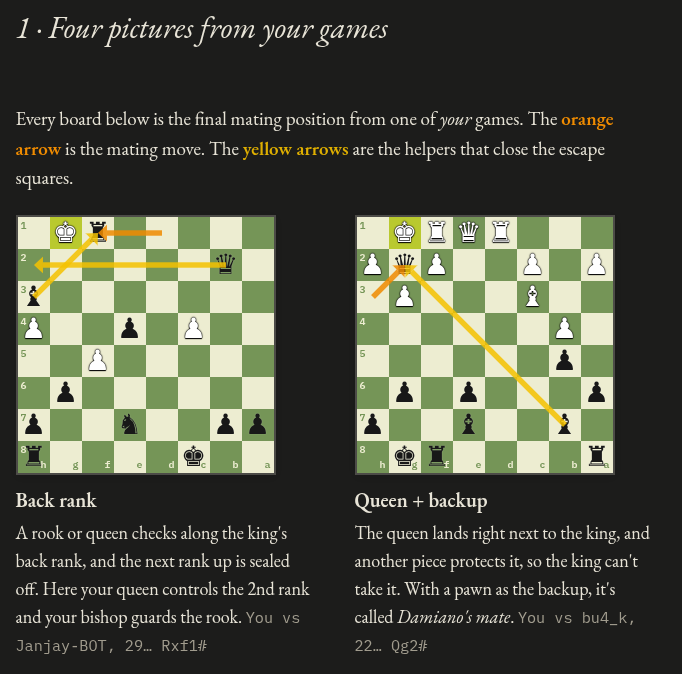
It asked where my habits came from
I always wanted to castle queenside in the Queen's Gambit because I was taught it was "more aggressive". It pointed out that the engine thinks castling long costs me in a lot of these lines. Then I went back and rewatched the video I'd learned it from (ChessPage1's Queen's Gambit video), and realized the video only castles long against specific defenses. I had carried it over to positions where it doesn't belong.
Instead of fighting the habit, it rebuilt the lesson around the video's move order. It even wrote down the takeaway for itself: "Before a correction, ask where a habit came from. A source the user trusts beats a 'better' move order they have to fight."
Missions instead of notation
That same video teaches openings as a list of "missions" for each piece: knight to c3, pin the knight with the bishop, push e3, and so on. I told the skill this worked way better for me than memorizing notation, and it rewrote its older opening lessons as numbered mission lists. The opening trainers even name the mission when I get a move wrong, so the hint is "you skipped the bishop's mission" instead of a square name I'd have to decode.
It fixed a misconception I didn't know I had
As Black I never traded my c-pawn for White's d-pawn, which is kind of the whole point of the Sicilian. When it asked why, I said I was afraid White's queen would just take on d4 for free and retreat. It explained that the trade is even, and in the move order it was teaching me, the queen recapture actually loses the queen. In my next 12 games as Black I made that trade 6 out of 6 times, compared to 0 out of 11 before.
Puzzles from my own blunders
The puzzle sets are positions from my own games, with the move I actually played set up as a trap. If I play the same bad move again, I get a message along the lines of "that's the move you played". Way more effective than random puzzles, because these are exactly the blind spots I have.
It caught a regression it caused
In my second week I dropped from about 730 to under 600, and I was pretty frustrated. It re-analyzed my games and found my openings and pace were unchanged. What had changed was converting winning positions: I won 67% of games where I was up +3 before, and 56% after. It also found that I'd started throwing out early queen checks with nothing to attack, and that the spike started the same day it taught me a queen check tactic. My hands had learned the move without the conditions.
The next lesson was a five-step routine for finishing won games, and it made a note to teach future tactics with the wrong version as a trap, since I generalize moves, not conditions. I also asked about tilt at one point, and it checked: my score after losing streaks was basically the same as my score after a win. So that was a story I was telling myself.
The result
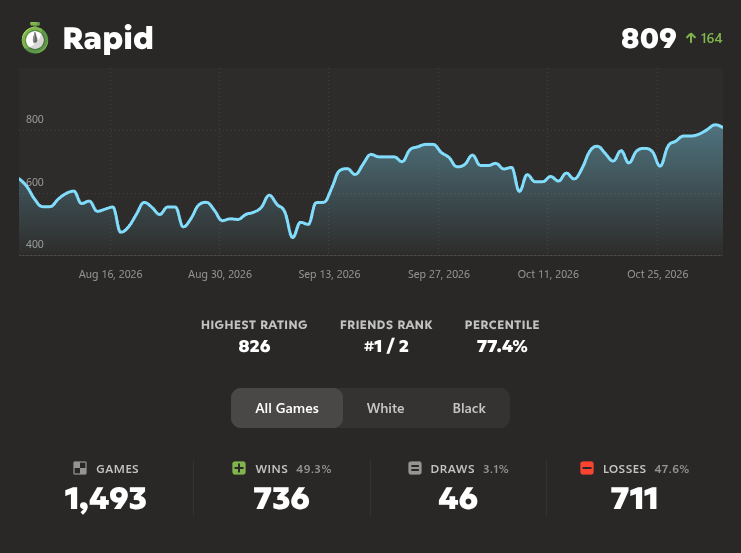
After about a month, I've crossed the 800 boundary. Not 1000 yet, but there's still time before the end of the year, and the course already knows what to look at next.
What makes this skill work isn't that it explains chess well (there are plenty of YouTube videos for that). It's that it holds a running model of me as a learner: what I'm trying to do, what I believe, what turned out to be wrong, and what to check next time. It also uses my real data to test its lessons instead of trusting that they worked.
If you want to try it on a non-programming skill, my advice is to give it real data about yourself on day one, be blunt about what you care about, and actually push back when a lesson isn't what you want. The learning records are where the value builds up, and they only get good if you tell it things.